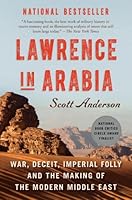
Lawrence in Arabia
Scott Anderson
Highlights & Annotations
Can you make room on your excavations next winter for a young Oxford graduate, T. Lawrence, who has been with me at Carchemish? He is a very unusual type, and a man whom I feel quite sure you would approve of and like.… I may add that he is extremely indifferent to what he eats or how he lives. DAVID HOGARTH TO EGYPTOLOGIST FLINDERS PETRIE, 1911
Ref. 7015-A
think it time I dedicated a letter to you,” Thomas Edward Lawrence wrote his father on August 20, 1906, “although it does not make the least difference in style, since all my letters are equally bare of personal information. The buildings I try to describe will last longer than we will, so it is only fitting that they should have the greater space.”
Ref. 02E6-B
There was another aspect to Lawrence that impressed the locals as well. He seemed to have none of the softness or frailty they associated with Europeans; rather, he could work in the blazing heat for hours without pause, could walk or ride for days without complaint, soldiered through bouts of dysentery and malaria with the composed resignation of a local. To the Arabs of Jerablus, most everything about Lawrence spoke of a toughness, a stamina and an austerity, that made him seem less like a European and more like themselves. In Arab tradition, they rewarded that sense of kinship with a fierce and abiding loyalty. This cut both ways, for the longer he stayed in Syria and the more he was accepted by the locals, the less Lawrence came to think and act like a Briton.
Ref. 0C75-C
Always my soul hungered for less than it had. T. E. LAWRENCE, SEVEN PILLARS OF WISDOM
Ref. AE58-D
imagined. One reason Europe’s imperial powers missed the warning signs was that these new instruments of war had previously been employed almost exclusively against those who didn’t have them—specifically, those non-Europeans who attempted to resist their imperial reach. In such situations, the new weapons had allowed for a lopsided slaughter not seen since the Spanish conquest of the Americas, and more than any other single factor had accounted for the dramatic expansion of Europe’s colonial empires into Asia and Africa in the latter part of the nineteenth century.
Ref. 1F6C-E
It is perversely appropriate, then, that among the few people who did appreciate this new face of war and the problems it would pose was the man who had officiated over more of these one-sided battlefield slaughters than probably anyone else alive: Lord Kitchener. At the battle of Omdurman in the Sudan in 1898, Kitchener had trained his Maxim machine guns on horsemen charging with spears; at a cost of forty-seven British army dead, he had killed ten thousand of the enemy in a single morning. But what would happen when the other side had Maxims too? Kitchener had a pretty good idea. At that cabinet meeting on August 7, where some other ministers imagined a conflict lasting months or even weeks, the newly appointed war secretary predicted years. “It will not end,” he told his colleagues, “until we have plumbed our manpower to the last million.” Naturally, these were words few wanted to hear, let alone pay heed to. And so as if imagining that nothing had really changed since the last great bout of European wars in Napoleonic times, the Scottish Highlanders gathered up their bagpipes and kilts, the French cuirassiers and Austrian lancers donned their armor breastplates and plumed helmets and, to the accompaniment of buglers and drums, marched gaily off to battle, not realizing until too late that their Europe was now to become an abattoir, a slaughtering pen into which, over the next four years, some ten million soldiers, along with an estimated six million civilians, would be hurried forward to their deaths.
Ref. C2A6-F
inured would the architects of the carnage become to such statistics that at the launch of his 1916 Somme offensive, British general Douglas Haig could look over the first day’s casualty rolls—with fifty-eight thousand Allied soldiers dead or wounded, it remains the bloodiest single day in the history of the English-speaking world—and judge that the numbers “cannot be considered severe.”
Ref. 8647-G
The effect of all this on the collective European psyche would be utterly profound. Initial euphoria would give way to shock, shock to horror, and then, as the killing dragged on with no end in sight, horror to a kind of benumbed despair. In the process, though, the European public would come to question some of the most basic assumptions about their societies. Among the things they would realize was that, stripped of all its high-minded justifications and rhetoric, at its core this war had many of the trappings of an extended family feud, a chance for Europe’s kings and emperors—many of them related by blood—to act out old grievances and personal slights atop the heaped bodies of their loyal subjects. In turn, Europe’s imperial structure had fostered a culture of decrepit military elites—aristocrats and aging war heroes and palace sycophants—whose sheer incompetence on the battlefield, as well as callousness toward those dying for them, was matched only by that of their rivals. Indeed, in looking at the conduct of the war and the almost preternatural idiocy displayed by all the competing powers, perhaps its most remarkable feature is that anyone finally won at all.
Ref. 1920-H
Interestingly, it appears his apprehensions had less to do with which side Turkey might join than with the act of joining itself. Part of this may have stemmed from a common denominator in European wars going back to the Crusades—no matter who won or lost, the one fairly reliable constant was that Jews somewhere were going to suffer—but it was also born of a particular feature of Ottoman war-making. In the event of conflict, both military and civilian authorities would suddenly have license to embark on a wholesale requisitioning spree—“pillaging” might be a more apt term—as they grabbed up whatever they deemed necessary for the war effort. While this campaign was sure to affect Arab and Jewish villages alike, it would naturally be more zealous in those modern or prosperous places that had more to offer—places like Zichron Yaakov and Athlit, for example. Already by mid-September 1914, the Aaronsohn family and their neighbors in Zichron began hiding away whatever they had of value, braced for the ruinous arrival of the requisition officer.
Ref. B381-I
Although Curt Prüfer was never much given to psychoanalysis, the few words he scribbled into his diary that night in describing the thirty-two-year-old Enver—by four months Prüfer’s junior—offer one of the more incisive portraits of the man who was to practically single-handedly destroy the Ottoman Empire: “A man of stone. A face immovable, well-formed, beautiful in the feminine sense. Groomed to the point of foppishness. Along with a streak of shocking hardness. ‘We can be more cruel than the British.’ The man wants something, but the something does not come.”
Ref. 05A7-J
His lack of awe probably also derived from the overall caliber of the building’s occupants. With most active-service military officers now in France, the General Staff had been filled out with men brought up from the reserves or mustered out of retirement, and even to Lawrence’s untrained eye it was clear many hadn’t a clue what they were supposed to be doing. As in any institution, this sense of inadequacy was often masked by an aura of extreme self-importance: at the War Office, freshly minted colonels and generals were forever striding briskly down hallways, memos in hand, or calling urgent staff meetings, or sending one of the Boy Scout messenger boys up to the Geographical Section for the latest map of Battlefield X, to be supplied ten minutes ago.
Ref. DC91-K
second lieutenant, while the paperwork for his “commission” was hastily drawn up. The uniform wouldn’t truly solve the problem, however; in the years ahead, Lawrence’s disregard for military protocol, manifested both in a usually unkempt appearance and a relaxed manner that bordered on the insolent, would drive his superior officers to distraction time and again.
Ref. 15AC-L
anyone else to wade into the morass? “Turkey seems at last to have made up its mind to lie down and be at peace with all the world,” Lawrence lamented to Winifred Fontana, the wife of the British consul in Aleppo, on October 19. “I’m sorry, because I wanted to root them out of Syria, and now their blight will be more enduring than ever.” But just two weeks later, his fears were put to rest. On November 2, with Enver Pasha’s faction having finally won out, Turkey came into the war on the side of Germany and Austria-Hungary.
Ref. 1DB8-M
The Raw Material” he laid out his opinion of its various cities and peoples in refreshingly blunt—at times comically arrogant—prose. Typical was his withering appraisal of Jerusalem: “Jerusalem is a dirty town which all Semitic religions have made holy.… In it the united forces of the past are so strong that the city fails to have a present; its people, with the rarest exceptions, are characterless as hotel servants, living on the crowd of visitors passing through.”
Ref. 6A8F-N
Even his laugh, which disclosed all his white teeth, was unpleasant and animal-like.”
Ref. 6A26-O
“Taking the Turkish Army as a whole,” one British officer had reported to his superiors in November 1914, “I should say it was [a] militia only moderately trained, and composed as a rule of tough but slow-witted peasants as liable to panic before the unexpected as most uneducated men.” Just what chance did this rabble have against the might of the British Empire? Ergo, why nip at their heels at Alexandretta when they could be beheaded at Constantinople?
Ref. D590-P
The meeting between the two fiercely headstrong
Ref. EF7C-Q
conducted in French. It got off to a rocky start. Along with outlining the modern techniques that could be used to combat the infestation, Aaronsohn took the opportunity to bluntly criticize the army’s wholesale requisitions that had left the region on the brink of ruin even before the locusts appeared. According to the story Aaronsohn would later tell, the governor finally interrupted his tirade with a simple question: “What if I were to have you hanged?” In a clever retort, alluding to both his considerable girth and to his network of influential friends abroad, the agronomist replied, “Your Excellency, the weight of my body would
Ref. EAA9-R