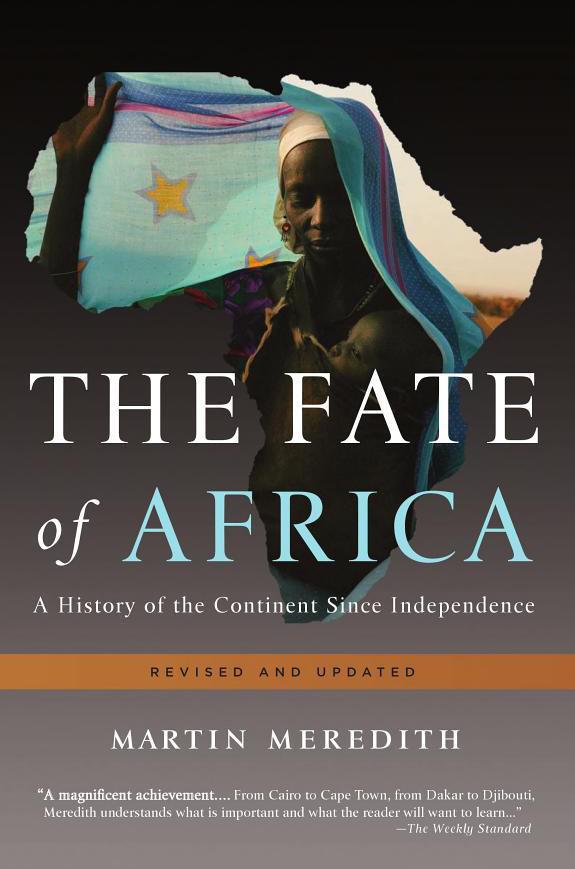
The Fate of Africa: A History of the Continent Since Independence
Martin Meredith
From Publishers WeeklyStarred Review. The value of Meredith's towering history of modern Africa rests not so much in its incisive analysis, or its original insights; it is the sheer readability of the project, combined with a notable lack of pedantry, that makes it one of the decade's most important works on Africa. Spanning the entire continent, and covering the major upheavals more or less chronologically—from the promising era of independence to the most recent spate of infamies (Rwanda, Darfur, Zimbabwe, Liberia, Sierra Leone)—Meredith (In the Name of Apartheid) brings us on a journey that is as illuminating as it is grueling. The best chapters, not surprisingly, deal with the countries that Meredith knows intimately: South Africa and Zimbabwe; he is less convincing when discussing the francophone West African states. Nowhere is Meredith more effective than when he gives free rein to his biographer's instincts, carefully building up the heroic foundations of national monuments like Nasser, Nkrumah, and Haile...
Highlights & Annotations
Africa, by the end of the 1980s, was renowned for its Big Men, dictators who strutted the stage, tolerating neither opposition nor dissent, rigging elections, emasculating the courts, cowing the press, stifling the universities, demanding abject servility and making themselves exceedingly rich. Their faces appeared on currency notes; their photographs graced offices and shops. They named highways, football stadiums and hospitals after themselves. Their speeches and daily activities dominated radio and television news and government newspapers. They packed the civil service with their own supporters and employed secret police to hunt down opponents, licensing them to detain, torture and murder at will, if necessary.
Ref. 92EB-A
In Côte d’Ivoire, after twenty-nine years in office, Félix Houphouët-Boigny, at the age of eighty-four, remained as adamantly in control as ever. ‘There is no number two, three of four,’ he said in 1988.
Ref. F799-B
Asked in 1989 why he wanted to change the system, Gbagbo replied: ‘I take inspiration from President Houphouët-Boigny. Everything he does is what we should not do. Look around Abidjan and you have the Houphouët-Boigny stadium, the Houphouët-Boigny bridge, the Houphouët-Boigny maternity centre. What we need is decentralisation. That is when people can take their own affairs into their own hands.
Ref. 6577-C
‘Babangida was seen as the most massively corrupt ruler in Nigerian history,’ wrote the American scholar Larry Diamond.
Ref. B1FF-D
A major portion of Nigeria’s economy involved illegal activity. More than $1 billion a year – equalling as much as 15 per cent of recorded government revenues – flowed into smuggling and fraud networks operated with the connivance of the ruling elite.
Ref. E84D-E
Babangida worked on the supposition, wrote Segun Osoba, in an essay on corruption in Nigeria, that ‘if he corrupted enough Nigerians there would be nobody to speak out on the issue of corruption or public accountability and so the matter would disappear from the national agenda’. He went on:
Ref. 5924-F
An investigation carried out in the post-Moi era found that almost half of Kenya’s judges and more than one-third of magistrates were corrupt. It revealed that the cost of bribery ranged from up to $190,000 for an Appeal Court judge to $20,000 for a High Court judge to $2,000 for a magistrate. As little as $500 would quash a murder conviction, while $250 would secure acquittal on a rape charge. One judge estimated that at least 20 per cent of prison inmates were wrongfully imprisoned because they could not afford to pay a bribe.
Ref. E046-G
Out of a list of fifty African countries in 1989, almost all were one-party states or military dictatorships
Ref. A221-H
Even Julius Nyerere, the most articulate spokesman for one-party systems in Africa, felt obliged to modify his support. ‘To view a one-party system in almost religious terms is wrong,’ he said in February 1990 after visiting Leipzig in East Germany. ‘We Tanzanians have one party as a historical necessity. But this is not a kind of divine decree. It is not proper to treat a person who floats the idea of a multi-party system as someone who has committed treason.’
Ref. 6FBC-I
Previously, Franco-African summits had been known as lavish, back-slapping family gatherings, full of empty talk.
Ref. 1D86-J
Three state-owned banks had collapsed in 1988 as a result of large unsecured loans awarded to members of Kérékou’s inner circle and the bogus companies they had set up, amounting in sum, according to the World Bank, to $500 million. His closest adviser, Mohammed Cissé, a Malian marabout, it was subsequently discovered, had been in the habit of sitting in the manager’s office at the Commercial Bank, transferring millions of dollars by telex to his bank accounts in Europe and the United States; in 1988 alone Cissé was estimated to have sent $370 million abroad.
Ref. 8637-K
The army, too, was restless, bubbling with plots; unpaid soldiers hijacked shipments of banknotes sent in from abroad to alleviate the crisis. Only Kérékou’s elite Presidential Guard, drawn exclusively from his northern ethnic group, remained loyal. Common to all the strikes and demonstrations that erupted in Benin during 1989 were demands for the payment of salary arrears but the focus turned increasingly on the call for a renouveau démocratique.
Ref. 67ED-L
After sustaining Mobutu in power for nearly thirty years, the United States had finally reached the end of the road. Appearing before the Subcommittee on Africa at the House of Representatives in October 1993, a former US assistant secretary of state for Africa, Herman Cohen, summed up what it had all come to:
Ref. 9866-M