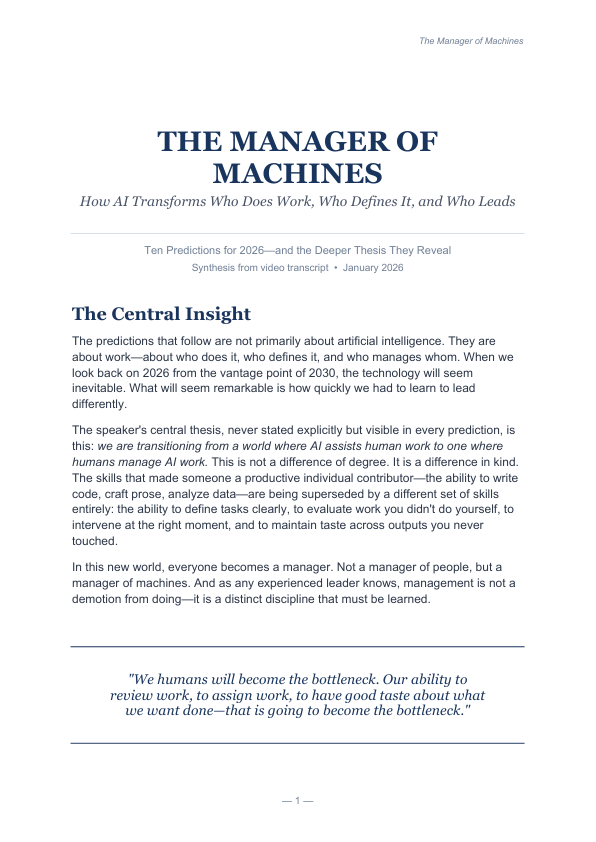
The Manager of Machines
Unknown
Highlights & Annotations
rence in kind. The skills that made someone a productive individual contributor—the ability to write code, craft prose, analyze data—are being superseded by a different set of skills entirely: the ability to define tasks clearly, to evaluate work you didn’t do yourself, to intervene at the right moment, and to maintain taste across outputs yo
Ref. 7A61-A
ction, is this: we are transitioning from a world where AI assists human work to one where humans manage AI work. This is not a difference of degree. It is a difference in kind.
Ref. 9221-B
where humans manage AI work. This is not a difference of degree. It is a difference in kind.
Ref. DA4F-C
here humans manage AI work. This is not a difference of degree. It is a difference in kind.
Ref. 88DF-D
“We humans will become the bottleneck. Our ability to
Ref. 1A98-E
uish this from the perfect memory some imagine for artificial superintelligence. Instead, think of it as functional memory: good enough to eliminate the most frustrating repetitions, comprehensive enough to feel like a colleague who has worked with yo
Ref. 685B-F
f it as functional memory: good enough to eliminate the most frustrating repetitions, comprehensive enough to feel like a colleague who has worked with you for m
Ref. 0F00-G
ems that remember context across sessions, maintain continuity of working relationships, and accumulate knowledge over time. The speaker is careful to distinguish this from the perfect memory some imagine for artificial superintelligence. Instead, think of it as functional memory: good enough to eliminate the most frustrating repetitions, comprehensive enough to feel like a colleague who has worked with you for months.
Ref. 5212-H
d, think of it as functional memory: good enough to eliminate the most frustrating repetitions, comprehensive enough to feel like a colleague who has worked with you for months.
Ref. E900-I
, think of it as functional memory: good enough to eliminate the most frustrating repetitions, comprehensive enough to feel like a colleague who has worked with you for months.
Ref. FB60-J
ems that remember context across sessions, maintain continuity of working relationships, and accumulate knowledge over time. The speaker is careful to distinguish this from the perfect memory some imagine for artificial superintelligence. Instead, think of it as functional memory: good enough to eliminate the most frustrating repetitions, comprehensive enough to feel like a colleague who has worked with you for months.
Ref. 5212-K
h this from the perfect memory some imagine for artificial superintelligence. Instead, think of it as functional memory: good enough to eliminate the most frustrating repetitions, comprehensive enough to feel like a colleague who has worked with you for months.
Ref. 1D3D-L
ou for months. The implementation will likely combine compression (distilling conversations to their essential facts), explicit memory writes (agents noting important information in persistent files), and retrieval mechanisms that surface relevant hi
Ref. ED8E-M
etitions, comprehensive enough to feel like a colleague who has worked with you for months.
Ref. 6080-O
you for months. The implementation will likely combine compression (distilling conversations to their essential facts), explicit memory writes (agents noting important information in persistent files), and retrieval mechanisms that surface relevant history at the right moments. This is systems engineering more than algorithmic brea
Ref. 02A0-P
mplementation will likely combine compression (distilling conversations to their essential facts), explicit memory writes (agents noting important information in persistent files), and retrieval mechanisms that surface relevant history at the right moments. T
Ref. 7DBA-Q
th you for months. The implementation will likely combine compression (distilling conversations to their essential facts), explicit memory writes (agents noting important information in persistent files), and retrieval mechanisms that surface relevant history at the right moments. This is systems engineering more than algorithmic breakthrough.
Ref. A875-R
. Every interaction currently carries the overhead of re-establishing context. Remov
Ref. 70D2-S
t helps you. This captures something important. The current paradigm—chat interfaces, code editors with copilots, specialized AI tools for specific tasks—will give way to something more ambient. An entity that lives in your computing environment,
Ref. 4845-U
you. This captures something important. The current paradigm—chat interfaces, code editors with copilots, specialized AI tools for specific tasks—will give way to something more ambient. An entity that lives in your computing environment
Ref. 6F44-V
- The Agent Software UI Breakthrough The speaker uses a charming phrase: the little guy in the computer that helps you.
Ref. F8D5-W
er that helps you. This captures something important. The current paradigm—chat interfaces, code editors with copilots, specialized AI tools for specific tasks—will give way to something more ambient. An entity that lives in your computing environment, observes what you’re doing, and offers assistance proactively.
Ref. 0061-X
elps you. This captures something important. The current paradigm—chat interfaces, code editors with copilots, specialized AI tools for specific tasks—will give way to something more ambient. An entity that lives in your computing environment, observes what you’re doing, and offers assistance proactively.
Ref. 06F1-Y
helps you. This captures something important. The current paradigm—chat interfaces, code editors with copilots, specialized AI tools for specific tasks—will give way to something more ambient. An entity that lives in your computing environment, observes what you’re doing, and offers assistance proactively.
Ref. E3C3-Z
elps you. This captures something important. The current paradigm—chat interfaces, code editors with copilots, specialized AI tools for specific tasks—will give way to something more ambient. An entity that lives in your computing environment, observes what you’re doing, and offers assistance proactively.
Ref. 06F1-A
ay you’d email an assistant, represents one early shape. But the speaker expects several startups to compete in this space, and whoever achieves the ChatGPT-like ‘could not live without it’ breakthrough will see explosive adoption.
Ref. 7191-B
r expects several startups to compete in this space, and whoever achieves the ChatGPT-like ‘could not live without it’ breakthrough will see explosive adoption.
Ref. 547A-C
. The rumored Anthropic email inbox, where you can simply send tasks to your agent the way you’d email an assistant, represents one early shape. But the speaker expects several startups to compete in this space, and whoever achieves the ChatGPT-like ‘could not live without it’ breakthrough will see explosive adoption.
Ref. AE0B-D
The Agent Software UI Breakthrough
Ref. 96A5-E
ored Anthropic email inbox, where you can simply send tasks to your agent the way you’d email an assistant, represents one early shape. But the speaker expects several startups to compete in this space, and whoever achieves the ChatGPT-like ‘could not live without it’ breakthrough will see explosive adoption.
Ref. 3103-F
ling factors are the hardware upgrades mentioned earlier (local tokenization becomes viable), plus mature orchestration patterns, plus the memory systems that let the agent maintain context. It is an assembly problem, not an invention pro
Ref. C39D-G
bling factors are the hardware upgrades mentioned earlier (local tokenization becomes viable), plus mature orchestration patterns, plus the memory systems that let the agent maintain context. It is an assembly problem, not an invention p
Ref. B511-H
PT-like ‘could not live without it’ breakthrough will see explosive adoption. The enabling factors are the hardware upgrades mentioned earlier (local tokenization becomes viable), plus mature orchestration patterns, plus the memory systems that let the agent maintain context. It is an assembly problem, not an invention problem.
Ref. 977A-I
information, that no longer wonder what ‘ChatGPT 5.2’ means because they
Ref. CF76-J
achines information, that no longer wonder what ‘ChatGPT 5.2’ means because the
Ref. 48DC-K
If your agent runs for a week and goes off the rails on day three, you need to know. We will need new technologies for observing work-in-process, new dashboards, new alert patterns. Agent management infrastructure will become its own category.
Ref. 9F77-L
The pattern is already visible in software engineering: AI writes code, AI reviews code, humans examine only what passes automated review. In 2026, this extends across work surfaces. Judge models, red-team passes, policy checkers, factuality validators, domain-specific linting for reasoning—all of these become standard components in agentic workflows.
Ref. 4B95-M
“The big win won’t be ‘AI can do the drafts.’ It will be ‘AI can audit drafts and ensure the work product is complete and consistent.’”
Ref. 3CBA-N
sis for this output?’ It will feel complex because enterprise demands—provenance, control, reproducibility—require complexity.
Ref. 16C1-O
Machines Become Proactive
Ref. 3946-P
Proactivity versus autonomy. Proactive AI that anticipates needs and interrupts helpfully sounds appealing until it starts to feel like surveillance, or worse, like a manager you never hired. The line between helpful colleague and invasive overseer will be contested.
Ref. 4CD7-Q