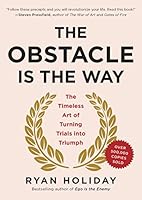
The Obstacle Is the Way
Ryan Holiday
Highlights & Annotations
Musonius Rufus. It is more than enough for us. Our actions may be impeded … but there can be no impeding our intentions or dispositions. Because we can accommodate and adapt. The mind adapts and converts to its own purposes the obstacle to our acting.
Ref. 53B9-A
The impediment to action advances action. What stands in the way becomes the way. In Marcus’s words is the secret to an art known as turning obstacles upside down. To act with “a reverse clause,” so there is always a way out or another route to get to where you need to go. So that setbacks or problems are always expected and never permanent. Making certain that what impedes us can empower us.
Ref. 63E2-B
Coming from this particular man, these were not idle words. In his own reign of some nineteen years, he would experience nearly constant war, a horrific plague, possible infidelity, an attempt at the throne by one of his closest allies, repeated and arduous travel across the empire—from Asia Minor to Syria, Egypt, Greece, and Austria—a rapidly depleting treasury, an incompetent and greedy stepbrother as co-emperor, and on and on and on.
Ref. C137-C
And from what we know, he truly saw each and every one of these obstacles as an opportunity to practice some virtue: patience, courage, humility, resourcefulness, reason, justice, and creativity.
Ref. 6DF9-D
He rarely rose to excess or anger, and never to hatred or bitterness.
Ref. 986E-E
We might not be emperors, but the world is still constantly testing us. It asks: Are you worthy? Can you get past the things that inevitably fall in your way? Will you stand up and show us what you’re made of?
Ref. 7502-F
“Bad companies are destroyed by crisis. Good companies survive them. Great companies are improved by
Ref. 6A93-G
find a way to transform weakness into strength. It’s a rather amazing and even touching feat. They took what should have held them back—what in fact might be holding you back right this very second—and used it to move forward.
Ref. BBCD-H
So this will be a book of ruthless pragmatism and stories from history that illustrate the arts of relentless persistence and indefatigable ingenuity.
Ref. FE61-I
It teaches you how to get unstuck, unfucked, and unleashed.
Ref. 94F8-J
How to turn the many negative situations we encounter in our lives into positive ones—or at least to snatch whatever benefit we can from them. To steal good fortune from misfortune.
Ref. 9B15-K
“The obstacle in the path becomes the path. Never forget, within every obstacle is an opportunity to improve our condition.”
Ref. EAC7-L
All great victories, be they in politics, business, art, or seduction, involved resolving vexing problems with a potent cocktail of creativity, focus, and daring.
Ref. 2639-M
When you have a goal, obstacles are actually teaching you how to get where you want to go—carving you a path. “The Things which hurt,” Benjamin Franklin wrote, “instruct.”
Ref. 0C27-N
Instead of opposing enemies, we have internal tension. We have professional frustration. We have unmet expectations. We have learned helplessness. And we still have the same overwhelming emotions humans have always had: grief, pain, loss.
Ref. 2AD4-O
Many of our problems come from having too much: rapid technological disruption, junk food, traditions that tell us the way we’re supposed to live our lives. We’re soft, entitled, and scared of conflict. Great times are great softeners. Abundance can be its own obstacle, as many people can attest.
Ref. 00FF-P
Our generation needs an approach for overcoming obstacles and thriving amid chaos more than ever. One that will help turn our problems on their heads, using them as canvases on which to paint master works. This flexible approach is fit for an entrepreneur or an artist, a conqueror or a coach, whether you’re a struggling writer or a sage or a hardworking soccer mom.
Ref. 0E24-Q
Objective judgment, now at this very moment. Unselfish action, now at this very moment. Willing acceptance—now at this very moment—of all external events. That’s all you need. —MARCUS AURELIUS
Ref. 44A1-R
It was this intense self-discipline and objectivity that allowed Rockefeller to seize advantage from obstacle after obstacle in his life, during the Civil War, and the panics of 1873, 1907, and
Ref. 4797-S
He had the strength to resist temptation or excitement, no matter how seductive, no matter the situation.
Ref. 47AA-T
For the rest of his life, the greater the chaos, the calmer Rockefeller would become, particularly when others around him were either panicked or mad with greed.
Ref. 7E70-U
This insight lives on today in Warren Buffet’s famous adage to “be fearful when others are greedy and greedy when others are fearful.”
Ref. 5FE7-V
“Oh, how blessed young men are who have to struggle for a foundation and beginning in life,” he once said. “I shall never cease to be grateful for the three and half years of apprenticeship and the difficulties to be overcome, all along the way.”
Ref. B9AB-W
You will come across obstacles in life—fair and unfair. And you will discover, time and time again, that what matters most is not what these obstacles are but how we see them, how we react to them, and whether we keep our composure. You will learn that this reaction determines how successful we will be in overcoming—or possibly thriving because of—them.
Ref. 367B-X
Looking the warden in the eye, Carter proceeded to inform him and the guards that he was not giving up the last thing he controlled: himself.
Ref. 1186-Y
“I know you had nothing to do with the injustice that brought me to this jail, so I’m willing to stay here until I get out. But I will not, under any circumstances, be treated like a prisoner—because I am not and never will be powerless.”
Ref. 5D51-Z
depths of solitary confinement. He had made his choice: This can’t harm me—I might not have wanted it to happen, but I decide how it will affect me. No one else has the right.
Ref. 1ADB-A
During the Overland Campaign, Grant was surveying the scene through field glasses when an enemy shell exploded, killing the horse immediately next to him. Grant’s eyes stayed fixed on the front, never leaving the glasses. There’s another story about Grant at City Point, Union headquarters, near Richmond. Troops were unloading a steamboat and it suddenly exploded. Everyone hit the dirt except Grant, who was seen running toward the scene of the explosion as debris and shells and even bodies rained down.
Ref. 637F-B
deploy any other skill. We must possess, as Voltaire once explained about the secret to the great military success of the first Duke of Marlborough, that “tranquil courage in the midst of tumult and serenity of soul in danger, which the English call a cool head.”
Ref. D6DC-C
When America raced to send the first men into space, they trained the astronauts in one skill more than in any other: the art of not panicking.
Ref. 22F1-D
When people panic, they make mistakes. They override systems. They disregard procedures, ignore rules. They deviate from the plan. They become unresponsive and stop thinking clearly. They just react—not to what they need to react to, but to the survival hormones that are coursing through their veins.
Ref. 073D-E
With enough exposure, you can adapt out those perfectly ordinary, even innate, fears that are bred mostly from unfamiliarity. Fortunately, unfamiliarity is simple to fix (again, not easy), which makes it possible to increase our tolerance for stress and uncertainty.
Ref. 4E8B-F
John Glenn, the first American astronaut to orbit the earth, spent nearly a day in space still keeping his heart rate under a hundred beats per minute. That’s a man not simply sitting at the controls but in control of his emotions. A man who had properly cultivated, what Tom Wolfe later called, “the Right Stuff.”
Ref. 7D14-G
As Gavin de Becker writes in The Gift of Fear, “When you worry, ask yourself, ‘What am I choosing to not see right now?’ What important things are you missing because you chose worry over introspection, alertness or wisdom?”
Ref. B2C4-H
The Greeks were clever. But beneath this particular quip is the fundamental notion that girds not just Stoic philosophy but cognitive psychology: Perspective is everything.
Ref. 31CA-I
That is, when you can break apart something, or look at it from some new angle, it loses its power over you.
Ref. AB85-J
explanation over the simple one, to our detriment. That we are scared of obstacles because our perspective is wrong—that a simple shift in perspective can change our reaction entirely. The task, as Pericles showed, is not to ignore fear but to explain it away. Take what you’re afraid of—when fear strikes you—and break it apart.
Ref. E438-K
What we’re forgetting in that instance, as billionaire serial entrepreneur Richard Branson likes to say, is that “business opportunities are like buses; there’s always another coming around.” One meeting is nothing in a lifetime of meetings, one deal is just one deal. In fact, we may have actually dodged a bullet. The next opportunity might be better.
Ref. D606-L
The way we look out at the world changes how we see these things. Is our perspective truly giving us perspective or is it what’s actually causing the problem? That’s the question.
Ref. 4B74-M
From Clooney’s new perspective, he was that solution. He wasn’t going to be someone groveling for a shot. He was someone with something special to offer. He was the answer to their prayers, not the other way around. That was what he began projecting in his auditions—not exclusively his acting skills but that he was the man for the job.
Ref. C310-N
The difference between the right and the wrong perspective is everything.
Ref. 1D41-O
In life our first job is this, to divide and distinguish things into two categories: externals I cannot control, but the choices I make with regard to them I do control. Where will I find good and bad? In me, in my choices. —EPICTETUS
Ref. EC46-P
It’s an almost superhuman accomplishment. But he was able to do it because he got really good at asking himself and others, in various forms, one question over and over again: Is there a chance? Do I have a shot? Is there something I can do?
Ref. 2472-Q
God, grant me the serenity to accept the things I cannot change The courage to change the things I can, And the wisdom to know the difference.
Ref. F35B-R
When it comes to perception, this is the crucial distinction to make: the difference between the things that are in our power and the things that aren’t.
Ref. 3242-S
Focusing exclusively on what is in our power magnifies and enhances our power.
Ref. 1BF2-T
The trick to forgetting the big picture is to look at everything close up. —CHUCK PALAHNIUK
Ref. 1E34-U
have to dive endlessly into what everything “means,” whether something is “fair” or not, what’s “behind” this or that, and what everyone else is doing.
Ref. 7C97-V
what things mean—why things are the way they are. As though the why matters. Emerson put it best: “We cannot spend the day in explanation.” Don’t waste time on false constructs.
Ref. D8B3-W
Now, how do you and I usually deal with an impossible deadline handed down from someone above us? We complain. We get angry. We question. How could they? What’s the point? Who do they think I am? We look for a way out and feel sorry for ourselves.
Ref. 17D1-X
weeks, they could surely make it one—there was no real difference in such a short period of time. And, more important, since they’d come this far and done so much good work, there was no way they would not ship on January 16, the original ship date. The engineers rallied and made their deadline. His insistence pushed them, once again, past what they ever thought possible.
Ref. BB51-Y
Now, how do we usually deal with an impossible deadline handed down from someone above us? We complain. We get angry. We question. How could they? What’s the point? Who do they think I am? We look for a way out and feel sorry for ourselves.
Ref. FE3C-Z
A good person dyes events with his own color … and turns whatever happens to his own benefit. —SENECA
Ref. C3CC-A
The Blitzkrieg strategy was designed to exploit the flinch of the enemy—he must collapse at the sight of what appears to be overwhelming force. Its success depends completely on this response. This military strategy works because the set-upon troops see the offensive force as an enormous obstacle bearing down on them.
Ref. A795-B
It’s one thing to not be overwhelmed by obstacles, or discouraged or upset by them. This is something that few are able to do. But after you have controlled your emotions, and you can see objectively and stand steadily, the next step becomes possible: a mental flip, so you’re looking not at the obstacle but at the opportunity within
Ref. 73E4-C
“There is good in everything, if only we look for it.”
Ref. 8EE9-D
Blessings and burdens are not mutually exclusive. It’s a lot more complicated. Socrates had a mean, nagging wife; he always said that being married to her was good practice for philosophy.
Ref. E146-E
—critical or question our abilities: Lower expectations are easier to exceed. —lazy: Makes whatever we accomplish seem all the more admirable.
Ref. 8FE5-F
Then imitate the action of the tiger; stiffen the sinews, summon up the blood. —SHAKESPEARE
Ref. 230F-G
advantage. People turn shit into sugar all the time—shit that’s a lot worse than whatever we’re dealing with. I’m talking physical disabilities, racial discrimination, battles against overwhelmingly superior armies.
Ref. EACE-I
learned to give entire speeches with a single breath. And soon, his quiet, weak voice erupted with booming, powerful clarity.
Ref. 7E7B-J
Demosthenes locked himself away underground—literally—in a dugout he’d had built in which to study and educate himself. To ensure he wouldn’t indulge in outside distractions, he shaved half his head so he’d be too embarrassed to go outside. And from that point forward, he dutifully descended each day into his study to work with his voice, his facial expressions, and his arguments.
Ref. BFA8-K
with energy with persistence with a coherent and deliberate process with iteration and resilience with pragmatism with strategic vision with craftiness and savvy and an eye for opportunity and pivotal moments
Ref. D34A-L
He had channeled his rage and pain into his training, and then later into his speeches, fueling it all with a kind of fierceness and power that could be neither matched nor resisted.
Ref. A4EA-M
advantage. People turn shit into sugar all the time—shit that’s a lot worse than whatever we’re dealing with. We’re talking physical disabilities, racial discrimination, battles against overwhelmingly superior armies.
Ref. C9EE-N
But those people didn’t quit. They didn’t feel sorry for themselves. They didn’t delude themselves with fantasies about easy solutions. They focused on the one thing that mattered: applying themselves with gusto and creativity.
Ref. 83BF-O
a coherent and deliberate process with iteration and resilience with pragmatism with strategic vision with craftiness and savvy and an eye for opportunity and pivotal moments
Ref. 53C7-P
Are you ready to get to work?
Ref. 0D36-Q
We must all either wear out or rust out, every one of us. My choice is to wear out. —THEODORE ROOSEVELT
Ref. ADD5-R
Because that’s what people who defy the odds do. That’s how people who become great at things—whether it’s flying or blowing through gender stereotypes—do. They start. Anywhere. Anyhow. They don’t care if the conditions are perfect or if they’re being slighted. Because they know that once they get started, if they can
Ref. E4B6-S
German Field Marshal General Erwin Rommel, on the other hand, loved it. He saw war as a game. A dangerous, reckless, untidy, fast-paced game. And, most important, he took to this game with incredible energy and was perennially pushing his troops forward.
Ref. CC11-T
While you’re sleeping, traveling, attending meetings, or messing around online, the same thing is happening to you. You’re going soft. You’re not aggressive enough. You’re not pressing ahead. You’ve got a million reasons why you can’t move at a faster pace. This all makes the obstacles in your life loom very large.
Ref. 52CA-U
Like Earhart, Rommel knew from history that those who attack problems and life with the most initiative and energy usually win. He was always pushing ahead, keeping the stampede on the more cautious British forces to devastating effect.
Ref. 32BF-V
He says the best way out is always through And I agree to that, or in so far As I can see no way out but through. —ROBERT FROST
Ref. E5A8-W
found it—proving that genius often really is just persistence in disguise. In applying the entirety of his physical and mental energy—in never growing weary or giving up—Edison had outlasted impatient competitors, investors, and the press to discover, in a piece of bamboo, of all things, the power to illuminate the world.
Ref. FE6C-X
n Silicon Valley, start-ups don’t launch with polished, finished businesses. Instead, they release their “Minimum Viable Product” (MVP)—the most basic version of their core idea with only one or two essential features.
Ref. B23A-Y
Too many people think that great victories like Grant’s and Edison’s came from a flash of insight. That they cracked the problem with pure genius. In fact, it was the slow pressure, repeated from many different angles, the elimination of so many other more promising options, that slowly and surely churned the solution to the top of the pile. Their genius was unity of purpose, deafness to doubt, and the desire to stay at it.
Ref. A6F3-Z
Remember and remind yourself of a phrase favored by Epictetus: “persist and resist.” Persist in your efforts. Resist giving in to distraction, discouragement, or disorder.
Ref. 0747-A
Doing new things invariably means obstacles. A new path is, by definition, uncleared. Only with persistence and time can we cut away debris and remove
Ref. 1966-B
What is defeat? Nothing but education; nothing but the first steps to something better. —WENDELL PHILLIPS
Ref. 9568-C
In Silicon Valley, start-ups don’t launch with polished, finished businesses. Instead, they release their “Minimum Viable Product” (MVP)—the most basic version of their core idea with only one or two essential features.
Ref. 28CB-D
And that means changing the relationship with failure. It means iterating, failing, and improving. Our capacity to try, try, try is inextricably linked with our ability and tolerance to fail, fail, fail.
Ref. 97FC-E
With a business, we take most failures less personally and understand they’re part of the process. If an investment or a new product pays off, great. If it fails, we’re fine because we’re prepared for it—we didn’t invest every penny in that option.
Ref. BA60-F
temporary failure certainly hurts less than catastrophic, permanent failure? Like any good school, learning from failure isn’t free. The tuition is paid in discomfort or loss and having to start over.
Ref. 2FA3-G
I know that seems almost too simple. But envision, for a second, a master practicing an exceedingly difficult craft and making it look effortless. There’s no strain, no struggling. So relaxed. No exertion or worry. Just one clean movement after another. That’s a result of the process.
Ref. 27A6-H
People fail in small ways all the time. But they don’t learn. They don’t listen. They don’t see the problems that failure exposes. It doesn’t make them better.
Ref. 5B05-I
Thickheaded and resistant to change, these are the types who are too self-absorbed to realize that the world doesn’t have time to plead, argue, and convince them of their errors.
Ref. D3F1-J
Soft bodied and hardheaded, they have too much armor and ego to fail well.
Ref. 14AF-K
Lessons come hard only if you’re deaf to them. Don’t be.
Ref. 6FB3-L
They say it for him, tattooing it at the front of their minds and on every action they take, because just two words are responsible for their unprecedented success: The Process.
Ref. 562F-M
“Don’t think about winning the SEC Championship. Don’t think about the national championship. Think about what you needed to do in this drill, on this play, in this moment. That’s the process: Let’s think about what we can do today, the task at hand.”
Ref. 41F8-N
In the chaos of sport, as in life, process provides us a way.
Ref. B466-O
Don’t focus on that. Instead break it down into pieces. Simply do what you need to do right now. And do it well. And then move on to the next thing. Follow the process and not the prize.
Ref. FD0C-P
Excellence is a matter of steps. Excelling at this one, then that one, and then the one after that. Saban’s process is exclusively this—existing in the present, taking it one step at a time, not getting distracted by anything else. Not the other team, not the scoreboard or the crowd.
Ref. 0F24-Q
Finishing film sessions. Finishing drives. Finishing reps. Finishing plays. Finishing blocks. Finishing the smallest task you have right in front of you and finishing it well.
Ref. 7A1A-R
And when you really get it right, even the hardest things become manageable.
Ref. 9AA7-S
Clay grabbed one of his posters, which had the word CLAY written in big letters. He looked at Espy and said, “You see that, boy?” pointing to a letter. “That’s an A. Now, you’ve only got twenty-five more
Ref. 5E03-T
Espy had just been gifted the process. Within a year, he started college.
Ref. EAAD-U
almost too simple. But envision, a master practicing an exceedingly difficult craft and making it look effortless. There’s no strain, no struggling. So relaxed. No exertion or worry. Just one clean movement after another. That’s a result of the process.
Ref. 1817-V
When it comes to our actions, disorder and distraction are death.
Ref. C3FA-W
The unordered mind loses track of what’s in front of it—what matters—and gets distracted by thoughts of the future. The process is order, it keeps our perceptions in check and our actions in sync.
Ref. 351A-X
Being trapped is just a position, not a fate. You get out of it by addressing and eliminating each part of that position through small, deliberate actions—not by trying (and failing) to push it away with superhuman strength.
Ref. 3352-Y
would collapse beneath the process. We’ve just wrongly assumed that it has to happen all at once, and we give up at the thought of it. We are A-to-Z thinkers, fretting about A, obsessing over Z, yet forgetting all about B through
Ref. AB0F-Z
Replace fear with the process. Depend on it. Lean on it. Trust in it.
Ref. 05F3-A
The process is about doing the right things, right now. Not worrying about what might happen later, or the results, or the whole picture.
Ref. B3B3-B
Whatever is rightly done, however humble, is noble. (Quidvis recte factum quamvis humile praeclarum.) —SIR HENRY ROYCE
Ref. 05E5-C
Steve Jobs cared even about the inside of his products, making sure they were beautifully designed even though the users would never see them. Taught by his father—who finished even the back of his cabinets though they would be hidden against the wall—to think
Ref. CAAA-D
In every design predicament, Jobs knew his marching orders: Respect the craft and make something beautiful.
Ref. CFCC-E
The great psychologist Viktor Frankl, survivor of three concentration camps, found presumptuousness in the age-old question: “What is the meaning of life?” As though it is someone else’s responsibility to tell you. Instead, he said, the world is asking you that question. And it’s your job to answer with your actions.
Ref. 0693-F
As Deng Xiaoping once said, “I don’t care if the cat is black or white, so long as it catches mice.” The Stoics had their own reminder: “Don’t go expecting Plato’s Republic.”
Ref. 5F46-G
In the meantime, cling tooth and nail to the following rule: not to give in to adversity, not to trust prosperity, and always take full note of fortune’s habit of behaving just as she pleases. —SENECA
Ref. F66A-H
Run it through your head like this: Nothing can ever prevent us from trying. Ever.
Ref. 27C0-I
It’s an infinitely elastic formula: In every situation, that which blocks our path actually presents a new path with a new part of us. If someone you love hurts you, there is a chance to practice forgiveness. If your business fails, now you can practice acceptance. If there is nothing else you can do for yourself, at least you can try to help others.
Ref. A329-J
We must prepare for adversity and turmoil, we must learn the art of acquiescence and practice cheerfulness even in dark times. Too often people think that will
Ref. ACCA-K
This is strikingly similar to what the Stoics called the Inner Citadel, that fortress inside of us that no external adversity can ever break down.
Ref. 7BD9-L
During the good times, we strengthen ourselves and our bodies so that during the difficult times, we can depend on it.
Ref. 641D-M
Are you okay being alone? Are you strong enough to go a few more rounds if it comes to that? Are you comfortable with challenges? Does uncertainty bother you? How does pressure feel?
Ref. 8DE9-N
That’s the point. The CEO is forcing an exercise in hindsight—in advance. She is using a technique designed by psychologist Gary
Ref. 94A1-O
A premortem is different. In it, we look to envision what could go wrong, what will go wrong, in advance, before we start. Far too many ambitious undertakings fail for preventable reasons. Far too many people don’t have a backup plan because they refuse to consider that something might not go exactly as they wish.
Ref. F917-P
get. Yet we constantly deny this fact and are repeatedly shocked by the events of the world as they unfold.
Ref. 0173-Q
No one has ever said this better than Mike Tyson, who, reflecting on the collapse of his fortune and fame, told a reporter, “If you’re not humble, life will visit humbleness upon you.”
Ref. 0AEF-R
Today, the premortem is increasingly popular in business circles, from start-ups to Fortune 500 companies and the Harvard Business Review. But like all great ideas, it is actually nothing new. The credit goes to the Stoics. They even had a better name: premeditatio malorum (premeditation of evils).
Ref. A899-S
“Nothing happens to the wise man against his expectation,” he wrote to a friend. “… nor do all things turn out for him as he wished but as he reckoned—and above all he reckoned that something could block his plans.”
Ref. 8ABF-T
Always prepared for disruption, always working that disruption into our plans. Fitted, as they say, for defeat or victory. And let’s be honest, a pleasant surprise is a lot better than an unpleasant one.
Ref. EF76-U
And that means people are going to make mistakes and screw up your plans—not always, but a lot of the time.
Ref. 3FB1-V
The only guarantee, ever, is that things will go wrong. The only thing we can use to mitigate this is anticipation. Because the only variable we control completely is ourselves.
Ref. 39FA-W
Beware the calm before the storm. Hope for the best, prepare for the worst. The worst is yet to come. It gets worse before it gets better.
Ref. 98AD-X
It’s better to meditate on what could happen, to probe for weaknesses in our plans, so those inevitable failures can be correctly perceived, appropriately addressed, or simply endured.
Ref. 77CD-Y
We’re like runners who train on hills or at altitude so they can beat the runners who expected the course would be flat.
Ref. B3A6-Z
But the person who has rehearsed in their mind what could go wrong will not be caught by surprise. The person ready to be disappointed won’t be. They will have the strength to bear it. They are not as likely to get discouraged or to shirk
Ref. 72E5-A
As Francis Bacon once said, nature, in order to be commanded, must be obeyed.
Ref. 5A50-B
My formula for greatness in a human being is amor fati: that one wants nothing to be different, not forward, not backward, not in all eternity. Not merely bear what is necessary, still less conceal it … but love it. —NIETZSCHE
Ref. 5C64-C
Edison calmly but quickly made his way to the fire, through the now hundreds of onlookers and devastated employees, looking for his son. “Go get your mother and all her friends,” he told his son with childlike excitement. “They’ll never see a fire like this again.” What?! Don’t worry, Edison calmed him. “It’s all right. We’ve just got rid of a lot of rubbish.” That’s a pretty amazing reaction. But when you think about it, there really was no other response.
Ref. 3F4B-D
To do great things, we need to be able to endure tragedy and setbacks. We’ve got to love what we do and all that it entails, good and bad. We have to learn to find joy in every single thing that happens.
Ref. E9E1-E
It is the act of turning what we must do into what we get to do.
Ref. 4D52-F
“Gentleman, I am hardening on this enterprise. I repeat, I am now hardening towards this enterprise.” —WINSTON CHURCHILL
Ref. BCC2-G
Persistence. Everything directed at one problem, until it breaks.
Ref. D867-H
But a ten-year voyage of trials and tribulations.
Ref. 2EBE-I
Ironhearted and ready to endure whatever punishment the Gods decide you must, and to do it with courage and tenacity in order to make it back to Ithaca?
Ref. 7D93-J
It’s about what happens not just in round one but in round two and every round after—and then the fight after that and the fight after that, until the end.
Ref. 8071-K
The Germans have a word for it: Sitzfleisch. Staying power. Winning by sticking your ass to the seat and not leaving until after it’s over.
Ref. 174F-L
We will overcome every obstacle—and there will be many in life—until we get there. Persistence is an action. Perseverance is a matter of will. One is energy. The other, endurance
Ref. 9658-M
Made weak by time and fate, but strong in will To strive, to seek, to find, and not to yield
Ref. 741F-N
The secret to his success, Pigafetta said, was Magellan’s ability to endure hunger better than the other men.
Ref. 7539-O
If our young men miscarry in their first enterprises, they lose all heart. If the young merchant fails, men say he is ruined. If the finest genius studies at one of our colleges, and is not installed in an office within one year afterwards in the cities or suburbs of Boston or New York, it seems to his friends and to himself that he is right in being disheartened, and in complaining the rest of his life.
Ref. BE34-P
We whine and complain and mope when things won’t go our way. We’re crushed when what we were “promised” is revoked—as if that’s not allowed to happen.
Ref. DA96-Q
Instead of doing much about it, we sit at home and play video games or travel or worse, pay for more school with more loan debt that will never be forgiven. And then
Ref. E437-R
Someone who is willing to try not one thing, but “tries all the professions, who teams it, farms it, peddles, keeps a school, preaches, edits a newspaper, goes to Congress, buys a township, and so forth, in successive years, and always, like a cat, falls on his feet.”
Ref. CE5D-S
“The barriers are not erected which can say to aspiring talents and industry, Thus far and no farther.”
Ref. F8F6-T
Death doesn’t make life pointless, but rather purposeful. And, fortunately, we don’t have to nearly die to tap into this energy.
Ref. 1868-U
As Shakespeare wrote in The Tempest not many years later, as he himself was growing older, “Every third thought shall be my grave.”
Ref. F8F7-V
Otherwise, we wouldn’t spend so much time obsessing over trivialities, or trying to become famous, make more money than we could ever spend in our lifetime, or make plans far off in the future. All of these are negated by death. All these assumptions presume that death won’t affect us, or at least, not when we don’t want it to. The paths of glory, Thomas Gray wrote, lead but to the grave.
Ref. E05D-W
The philosopher and writer Nassim Nicholas Taleb defined a Stoic as someone who “transforms fear into prudence, pain into transformation, mistakes into initiation and desire into undertaking.” It’s a loop that becomes easier over time.
Ref. D815-X
As the Haitian proverb puts it: Behind mountains are more mountains.
Ref. 8B8A-Y
Elysium is a myth. One does not overcome an obstacle to enter the land of no obstacles.
Ref. 2D44-Z
On the contrary, the more you accomplish, the more things will stand in your way. There are always more obstacles, bigger challenges. You’re always fighting uphill.
Ref. 2C29-A
Knowing that life is a marathon and not a sprint is important.
Ref. 9048-B
Never rattled. Never frantic. Always hustling and acting with creativity. Never anything but deliberate. Never attempting to do the impossible—but everything up to that line.
Ref. CA9D-C
They would capture Cassius and endeavor not to kill him, but “… forgive a man who has wronged one, to remain a friend to one who has transgressed friendship, to continue faithful to one who has broken faith.”
Ref. 80A8-D
course, as so often happens, even the most well-intentioned plans can be interrupted by others.
Ref. E06D-E
What stood in the way became the way. What impeded action in some way advanced it.
Ref. 909B-F
Tested in the crucible of adversity and forged in the furnace of trial, they realized these latent powers—the powers of perception, action, and the will.
Ref. EDCD-G
option unexplored, then stand strong and transform whatever can’t be changed.
Ref. C6F4-H
The philosopher and writer Nassim Nicholas Taleb defined a Stoic as someone who “transforms fear into prudence, pain into information, mistakes into initiation and desire into undertaking.” It’s a loop that becomes easier over time.
Ref. 4C90-I
There’s a saying in Latin: Vires acquirit eundo (We gather strength as we go).
Ref. 08B8-J
Of course, it is not enough to simply read this or say it. We must practice these maxims, rolling them over and over in our minds and acting on them until they become muscle memory.
Ref. 97B6-K
So that under pressure and trial we get better—become better people, leaders, and thinkers. Because those trials and pressures will inevitably come. And they won’t ever stop coming.
Ref. BE5F-L
You are schooled in the art of managing your perceptions and impressions. Like Rockefeller, you’re cool under pressure, immune to insults
Ref. 144B-M
Frederick the Great was said to ride with the works of the Stoics in his saddlebags because they could, in his words, “sustain you in misfortune.”
Ref. 7E25-N
When Thomas Jefferson died, he had a copy of Seneca on his nightstand.
Ref. 1CD7-O
wrote of Marcus Aurelius and Stoicism in his famous treatise On Liberty, calling it “the highest ethical product of the ancient mind.”
Ref. D1A9-P
that same statue of Marcus Aurelius in Rome that “if Meditations is antiquity, it is we who are the ruins.”
Ref. 580A-Q
And as he parachuted from his plane, Stockdale said to himself “I’m leaving the world of technology and entering the world of Epictetus.”
Ref. A01E-R
I want to thank Samantha, my girlfriend, whom I love more than anyone. We’d only been dating a few weeks, but I knew she was special when she went out and bought this book Meditations, the book I had been raving about. She deserves extra credit if only for enduring my many private and admittedly unstoic moments over the years. Thank you for coming on the many walks with me where I thought out loud. I want to thank my dog, Hanno—not that she is reading this—because she is a constant reminder of living in the present and of pure and honest joy.
Ref. 9F0C-S