The Promise of Multi-Agent AI
Joanne Chen
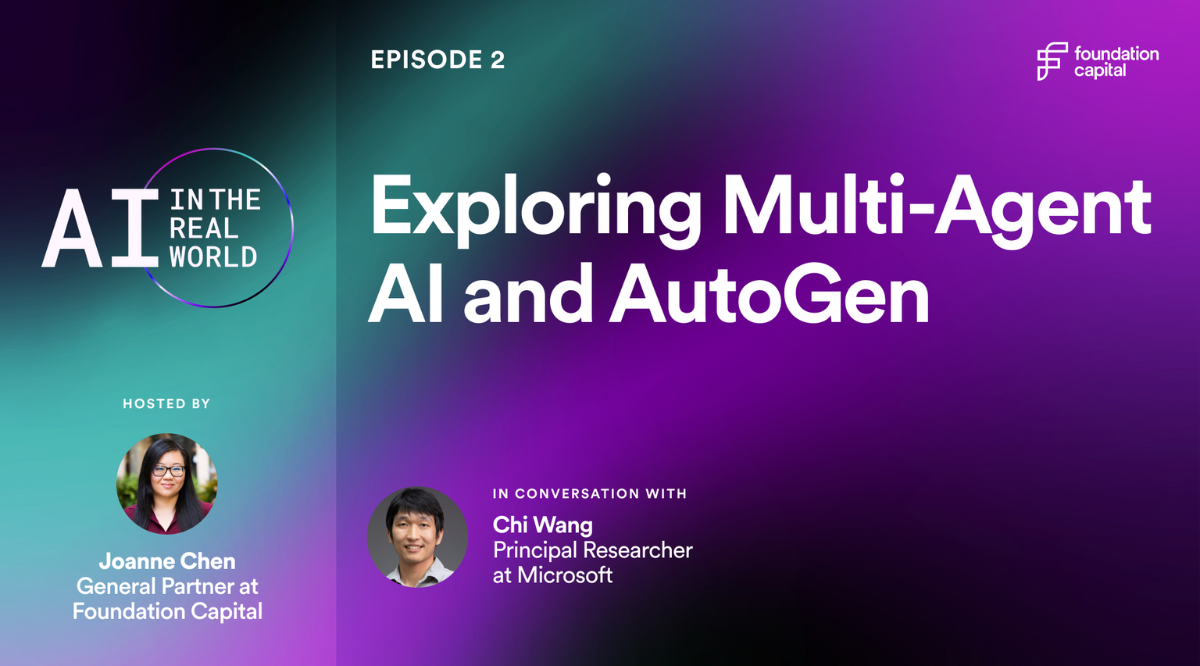
Multi-agent systems improve AI by allowing specialized agents to work together on complex tasks. This collaboration leads to better problem-solving and more advanced capabilities than single agents can achieve alone. Researchers believe multi-agent AI can revolutionize how we automate and tackle challenging problems.
Highlights & Annotations
This is where multi-agent systems come in. By breaking down complex problems into discrete subtasks that are handled by specialized agents, these systems offer a modular, flexible, and resilient approach to automating tasks that were previously considered beyond software’s reach. Leading multi-agent frameworks like Microsoft’s open-source AutoGen are currently powering a wide range of academic and enterprise use cases, including synthetic data generation, code generation, and pharmaceutical data science.
Ref. 9C65-A
To answer this question, it’s helpful to go back to the origins of multi-agent cognition, which can be traced back to Marvin Minsky’s classic 1986 book, The Society of Mind. Here, Minsky proposed that human cognition arises from the interaction of numerous simple “agents”—simple entities designed to perform certain functions, such as recognizing a shape or processing emotions. He posited that by combining these agents in specific ways (into networks or “societies”), intelligent behavior could arise—a phenomenon he termed the “Society of Mind.” Minsky’s key insight was that thousands of modular minds working in concert could outperform a single monolithic mind.
Ref. 063B-B
Distributing complex tasks across specialized agents makes the overall system more modular. This modularity simplifies development, testing, and maintenance, as capabilities can be added or tweaked without revamping the entire system. Troubleshooting is also streamlined, as issues can often be isolated to individual agents.
Ref. 69D1-C
Think of multi-agent systems as teams of experts, each contributing unique knowledge and abilities to collectively tackle difficult problems. Tasks are broken down into components and assigned to the agent best equipped to handle them. As each agent processes its part of the task and passes information to the next, the output is progressively refined and improved. Through such specialization, the resulting systems can achieve results that generalist agents struggle to match.
Ref. DF2A-D
This approach is conceptually similar to techniques like prompt chaining, where a human user breaks down an intricate task into a series of subtasks and iterates toward a desired outcome through conversation with the model.
Ref. 9ACE-E
Chi offers the example of a multi-agent system tasked with analyzing data and providing insights and recommendations. In this scenario, each agent focuses on a different aspect of the task: some specialize in data retrieval and presentation, others in deep analysis and insight generation, and others in planning and decision-making. This division of labor allows each agent to work on what it does best, leading to faster, more accurate outcomes.
Ref. 394C-F
The beauty of collaborative learning lies in its ability to generate creative solutions that might elude a more homogeneous system. As agents converse and build on each other’s ideas, they can explore a wider range of possibilities and uncover approaches that individual agents might overlook. These synergies are the key to unlocking the full potential of multi-agent systems. As inference techniques improve, such inter-agent exchanges will only become faster and more efficient.
Ref. B424-G
Choosing the right architecture is critical, as multi-agent systems introduce myriad complexities around coordination, consistency, and coherence that single-agent setups avoid. For straightforward, narrowly defined tasks, a lone agent may be the simpler, more efficient choice. Factors such as response speed, decision-making frequency, inter-agent communication needs, latency, and bandwidth all influence the decision between single and multi-agent architectures.
Ref. 1E00-H
Start simple, then scale. By deploying one or two agents initially and incrementally scaling up, developers can validate the core design and interaction patterns before introducing additional complexity. This approach also streamlines debugging and optimization, as issues can be more easily traced back to individual agents.
Ref. 58E5-I
In multi-agent systems, specialization breeds strength. Developers should adopt a divide-and-conquer approach, allowing each agent to focus on its area of expertise. This goes beyond simple prompt engineering: agents can be equipped with task-specific resources and tools, such as access to databases and specialized software, along with clearly defined rules and constraints that guide them toward desired outcomes. Effective design involves mapping out the subtasks required to achieve the overall objective, understanding their interdependencies, and assigning agents accordingly based on their specialties and the system’s evolving needs.
Ref. 6A72-J
Seamless communication between agents is crucial, and both static and dynamic topologies have their merits. In static setups, the communication channels linking agents are predefined and unchanging. This approach prioritizes simplicity and predictability, making the system easier to understand, analyze and debug.
Ref. 5A22-K
Dynamic topologies, by contrast, allow agents to create and modify communication links on the fly, thus enabling them to adapt to shifting circumstances and requirements. Imagine a disaster response scenario where agents represent different emergency services. Within a dynamic topology, these agents can fluidly connect and coordinate based on real-time data like incident locations and resource needs. This adaptability enables the system to mount a more effective and targeted response to evolving crisis conditions—yet it also makes analyzing and overseeing the system more difficult.
Ref. E0BE-L
Striking the right balance between agent autonomy and control is an ongoing challenge. Too little autonomy can result in a rigid, limited system, while too much autonomy may lead to unstable or unexpected behaviors. Adjustable autonomy, which allows for dynamic, context-dependent changes in the level of control exerted over agents, is an active area of research.
Ref. D3A4-M
Most multi-agent systems involve human users to some degree—which means that innovative interaction design is essential. Agents need effective mechanisms for conveying relevant information to human stakeholders, soliciting input and direction as needed, and modify their behaviors in response to feedback.
Ref. 76C3-N
A primary design consideration is whether to present the multi-agent system to users as a unified, monolithic entity or as a collection of distinct, interacting agents. In the former case, users might interact with the system through a single interface, regardless of the number and diversity of agents operating behind the scenes. In the latter, users would need to communicate with multiple agents individually, potentially using different interfaces and interaction patterns for each.
Ref. 88F4-O
Advanced reasoning, planning, and problem-solving: By equipping agents with higher-level cognitive skills—such as the ability to break down multifaceted problems, explore novel solution spaces, and adapt to changing circumstances —we can expand the range and sophistication of tasks they can tackle. Techniques like chain-of-thought prompting and multi-agent debate are early efforts in this direction.
Ref. 69A4-P
Grounding agents in reality: For multi-agent systems to truly realize their potential, they need to be grounded in the real world rather than operating in isolation. By linking agents to physical tools and sensors, realistic virtual environments, and live data streams, we can anchor their intelligence in the tangible contexts where they’ll be deployed.
Ref. 8CDC-Q
Automating agent orchestration: As multi-agent systems grow in size and sophistication, manually designing and tuning the roles and interaction patterns of individual agents will quickly become untenable. To address this challenge, researchers are developing adaptive architectures and learning techniques that use LLMs to automatically configure and optimize agent-based systems.
Ref. 552F-R